
Trauma Awareness and Trauma-Informed Practice in Our Communities | Wenpower CIC
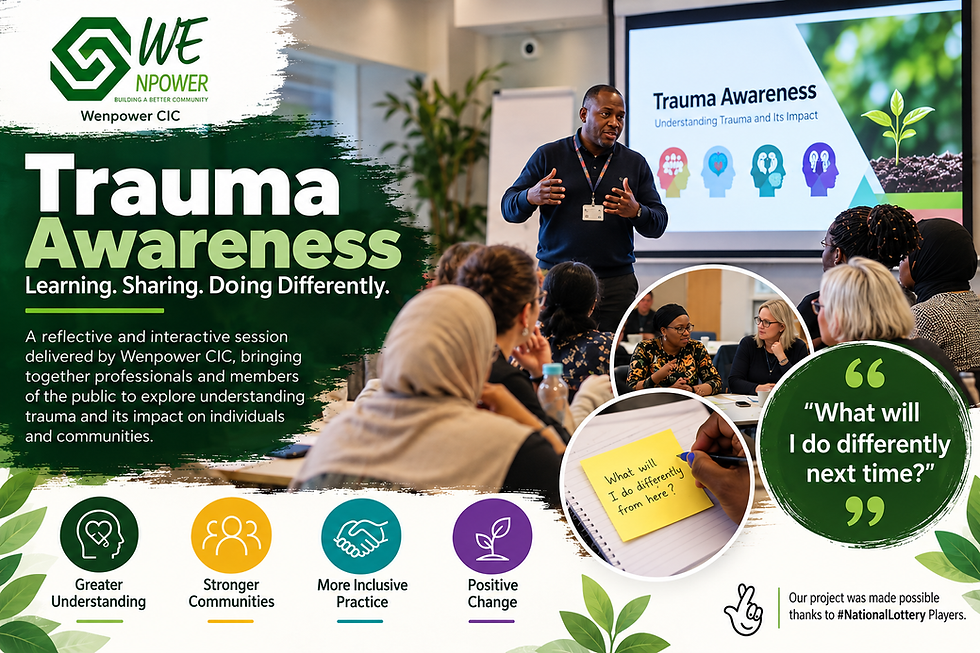
On 3 September 2026, Wenpower CIC delivered an interactive Trauma Awareness session in collaboration with BAVO, bringing together professionals and members of the public who wanted to deepen their understanding of trauma and its impact on individuals and communities.
The session, developed and delivered by Wenpower CIC, was not intended simply to provide information. We wanted to create a space where people could learn, reflect, discuss and challenge themselves to think differently about how we respond to people who may have experienced trauma.
Understanding what sits behind behaviour
One of the important themes explored during the session was that trauma is not defined simply by what happened to someone. The presentation explored the relationship between the event, the person's experience of it, and its subsequent effect. Two people may experience similar circumstances and be affected very differently.
We explored acute, chronic and complex trauma, as well as some of the many experiences that can contribute to trauma across a person's lifetime.
Importantly, we also considered trauma within diverse communities. Migration and displacement may involve loss, grief, uncertainty, separation from family and challenges around identity. Language barriers, racism, discrimination, cultural adjustment and previous experiences of services or authority can further influence people's wellbeing, trust and willingness to engage.
This led to an important message:
Sometimes what we see as a person's behaviour may actually be a response to distress.
Withdrawal, hypervigilance, emotional reactions, difficulty concentrating and resistance to change can all be ways in which trauma presents itself.
Rather than immediately asking "What's wrong with this person?", a trauma-informed perspective encourages us to become more curious about what may have happened and what the person may need to feel safe enough to engage.
From awareness to trauma-informed practice
The discussion then moved from understanding trauma to considering what we can practically do differently.
We explored six important principles of trauma-informed practice: safety, trust, choice, collaboration, empowerment and cultural responsiveness.
These principles are relevant far beyond clinical settings. They can influence how community organisations, public services, workplaces, volunteers and professionals communicate with and support people.
Sometimes relatively small changes in how we listen, communicate, offer choice or create psychological safety can make an important difference.
Learning from each other
What made the session particularly valuable was the participation of the people in the room.
Although Wenpower developed and delivered the content, learning was not one-way.
Participants contributed experiences, observations, questions and perspectives from their own professional and community contexts.
We discussed questions including:
What challenges are we seeing in our communities?
What helps people feel safe enough to engage?
Where could a trauma-informed approach strengthen our current practice?
Those conversations and the feedback we received were equally valuable to us. They reinforce why community learning works best when people are not simply presented to, but are given space to participate, reflect and contribute.
One question to take away
We concluded with a simple but powerful reflection:
“What is one thing you will do differently next time?”
That question matters because awareness by itself is not enough.
For Wenpower CIC, this is part of a wider commitment to early intervention, mental health and wellbeing, trauma-informed support, inclusion and stronger communities.
We are grateful to BAVO for collaborating with us and helping create the opportunity for professionals and members of the public to come together, learn and share their experiences.
The conversation does not end with one workshop. It is about continuing to build communities and services where people feel seen, heard, respected and safe enough to engage.


Our project was made possible thanks to #NationalLottery Players.



Comments